
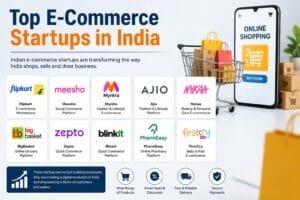
India’s e-commerce industry has grown rapidly with the rise of online marketplaces, quick commerce, D2C brands, B2B platforms, and technology-driven retail services. Top E-Commerce Startups in India are changing how customers discover, purchase, and receive products. From affordable online shopping and fashion to grocery delivery, logistics, and specialized marketplaces, these businesses are creating new opportunities for consumers and sellers.
Recent startup rankings show that India’s e-commerce ecosystem includes marketplaces, quick-commerce companies, B2B platforms, D2C businesses, and technology-enabled e-commerce services.
What Makes Top E-Commerce Startups in India Successful?
The Top E-Commerce Startups in India are not all based on the same business model. Some focus on marketplaces, while others specialize in quick delivery, fashion, beauty, logistics, or B2B commerce.
Successful e-commerce startups generally focus on:
◆ Customer convenience
◆ Competitive pricing
◆ Technology
◆ Product selection
◆ Fast delivery
◆ Digital payments
◆ Logistics
◆ Customer experience
◆ Seller accessibility
The combination of technology, internet adoption, digital payments, and changing shopping habits continues to support India’s e-commerce ecosystem.
Explore more:E-Commerce Companies in Delhi for Sellers: 7 Effective Ways to Choose the Right Partner
Top E-Commerce Startups in India to Know
1. Meesho
Meesho is a major Indian e-commerce marketplace focused on making online commerce more accessible to consumers and small businesses. Its marketplace connects sellers with customers across India and supports sellers with logistics, payments, and customer-service capabilities.
Its value-focused approach has helped it become an important platform, particularly for customers and sellers beyond India’s largest metropolitan areas.
2. Zepto
Zepto is one of India’s prominent quick-commerce startups. It focuses on delivering groceries and everyday products rapidly through a network of dark stores.
The company has attracted significant investor attention as India’s quick-commerce sector has expanded. In 2025, Zepto announced a major funding round at a valuation of approximately $7 billion.
3. Lenskart
Lenskart has built a strong position in India’s eyewear market through a combination of online shopping, physical stores, technology, and its own retail infrastructure.
Its full-stack approach includes manufacturing, retail, logistics, and direct-to-consumer sales. In 2026, the company received significant investor attention following its public-market debut.
4. Nykaa
Nykaa is a leading Indian beauty and fashion e-commerce company. It has developed an online platform around beauty products, personal care, cosmetics, fashion, and related categories.
Its specialized category focus has helped establish it as one of India’s notable consumer internet and e-commerce businesses.
5. FirstCry
FirstCry focuses primarily on products for babies, children, and parents. Its business model combines online commerce with an extensive retail presence.
The company has become an important name in India’s specialized e-commerce sector, particularly for children’s products and parenting-related shopping.
6. Shiprocket
Shiprocket is an e-commerce logistics and technology company that helps online businesses manage shipping and fulfilment requirements.
Its importance extends beyond traditional online marketplaces because logistics is a critical part of e-commerce. In August 2026, Shiprocket made its stock-market debut, reaching a valuation of approximately $1.05 billion during its first trading session.
7. Udaan
Udaan operates in the B2B e-commerce space, connecting businesses and retailers with products and suppliers through a technology-enabled platform.
B2B commerce is an important part of India’s broader e-commerce ecosystem because it helps retailers and businesses source products digitally.
8. CityMall
CityMall is another Indian e-commerce startup focused on connecting consumers with products through a community-oriented commerce model.
It has been included among India’s leading funded e-commerce startups in recent rankings, reflecting the growing diversity of India’s online-commerce ecosystem.
Why These E-Commerce Startups Are Important
The Top E-Commerce Startups in India are contributing to the development of different parts of the digital economy.
✦ Expanding Online Shopping
E-commerce startups are making online shopping accessible to customers across different cities and regions.
✓ Creating Opportunities for Sellers
Marketplace-based businesses allow brands, manufacturers, retailers, and small businesses to reach customers online.
★ Improving Delivery
Quick-commerce and logistics companies are developing faster and more technology-driven fulfilment systems.
🚀 Encouraging Innovation
Startups are experimenting with new business models, customer experiences, payment systems, logistics networks, and technology.
Explore more:Ecom Grow Services for E-Commerce Businesses: 7 Effective Ways to Grow Your Online Store
Key E-Commerce Trends in India
India’s e-commerce industry is no longer limited to traditional online marketplaces. Several models are growing simultaneously.
◆ Quick Commerce
Companies such as Zepto and other quick-commerce businesses are focusing on rapid delivery of groceries and everyday products.
◆ Social and Value Commerce
Platforms such as Meesho have focused on making online shopping more accessible and supporting smaller sellers.
◆ Specialized E-Commerce
Businesses such as Lenskart, Nykaa, and FirstCry demonstrate how specialized categories can create strong online brands.
◆ B2B E-Commerce
Companies such as Udaan are helping businesses and retailers adopt digital procurement and commerce.
◆ E-Commerce Logistics
Companies such as Shiprocket demonstrate the importance of technology-enabled shipping and fulfilment in online retail.
Benefits of E-Commerce Startups for Sellers
The growth of e-commerce startups can create several opportunities for online sellers.
⏱ Wider Customer Reach
Sellers can use online platforms to reach customers outside their local markets.
📂 Better Digital Operations
Technology can simplify product management, payments, shipping, inventory, and customer communication.
✓ Multiple Selling Channels
Businesses can choose marketplaces, D2C websites, social commerce, B2B platforms, or specialized platforms according to their products.
📈 Business Expansion
Online marketplaces can help smaller brands test new markets and gradually expand their customer base.
🌍 Access Beyond Major Cities
The growth of e-commerce is increasingly reaching Tier-II and Tier-III markets, creating opportunities for sellers outside major metropolitan areas.
Explore more:ONDC Catalogue Management Service Noida: 7 Powerful Benefits for Better Digital Commerce Growth
How to Choose the Right E-Commerce Platform for Your Business
Before selecting an e-commerce platform, sellers should consider:
◆ Product category
◆ Target customers
◆ Marketplace fees
◆ Seller requirements
◆ Logistics options
◆ Competition
◆ Advertising opportunities
◆ Return policies
◆ Customer reach
◆ Available seller-support services
The best platform depends on the seller’s products, business model, budget, and target market.
Common Challenges for E-Commerce Startups
⚠️ Strong Competition
India’s e-commerce sector includes large marketplaces, established companies, specialized startups, and rapidly growing new businesses.
❌ Profitability Pressure
Fast expansion can involve significant spending on technology, logistics, customer acquisition, and fulfilment.
⚠️ Logistics Complexity
Managing deliveries, returns, inventory, and fulfilment across a large country requires strong operational systems.
❌ Customer Expectations
Customers increasingly expect competitive prices, fast delivery, easy returns, and reliable service.
Frequently Asked Questions
1. What are the Top E-Commerce Startups in India?
Some notable names include Meesho, Zepto, Lenskart, Nykaa, FirstCry, Shiprocket, Udaan, and CityMall.
2. Is Meesho an e-commerce startup?
Yes. Meesho operates an online marketplace connecting sellers with customers across India.
3. Is Zepto an e-commerce company?
Yes. Zepto operates in the quick-commerce segment, focusing on rapid delivery of groceries and everyday products.
4. Is Lenskart an e-commerce startup?
Lenskart began as an online eyewear business and has developed into an omnichannel eyewear company combining digital and physical retail.
5. What is Shiprocket known for?
Shiprocket is known for technology-enabled e-commerce shipping, fulfilment, and logistics services.
6. Which e-commerce startups focus on specialized categories?
Lenskart focuses on eyewear, Nykaa on beauty and fashion, and FirstCry on baby and children’s products.
7. Are e-commerce startups useful for small sellers?
Yes. Marketplaces and e-commerce platforms can help smaller businesses reach customers beyond their local markets.
8. Is quick commerce part of e-commerce?
Yes. Quick commerce is a rapidly developing segment of e-commerce focused on fast delivery of products.
9. Are e-commerce startups growing in India?
Yes. Recent industry data shows continued activity across marketplaces, quick commerce, B2B commerce, D2C businesses, and e-commerce technology companies.
Conclusion
The Top E-Commerce Startups in India represent a diverse and rapidly developing digital-commerce ecosystem. From Meesho’s marketplace model and Zepto’s quick-commerce approach to Lenskart’s omnichannel eyewear business and Shiprocket’s logistics technology, different companies are solving different challenges in online commerce.
For sellers and entrepreneurs, this growing ecosystem creates opportunities to reach new customers, explore different selling channels, and build scalable online businesses. As technology, logistics, digital payments, and online shopping continue to develop, India’s e-commerce startup landscape is likely to remain an important part of the country’s digital economy.